Sunday, January 19, 2020

Why is the #MeToo Movement Ignored in the Presidential Debates?


 The #MeToo movement and women’s equality have been pretty much ignored in the presidential debates. It’s been two years since the #MeToo hashtag went viral, exposing prominent men in the entertainment industry, sports, and politics for sexual assault and harassment. I am wondering why the #MeToo movement is absent from debate rhetoric, since women comprise over half of the US population and over five million women tweeted about their experiences with rape and sexual assault in October, 2017, after a tweet by actress Alyssa Milano, inviting survivors to share their stories. Tarana Burke, who created the #MeToo movement in 2007 has said, “Centering sexual violence in the 2020 election is critical because it’s been two years since millions of people spoke out and said ‘me too'. Those people are still waiting for a response from our national leaders” (https://www.huffpost.com/entry/me-too-democratic-presidential-candidates_n_5e1de8d0c5b6640ec3dc0371?ncid=newsltushpmgintwomen).

Tarana Burke has created a new hashtag, #MeTooVoter, to raise awareness about the abuse of power by powerful men in industries, and  to try to get debate moderators and presidential candidates to recognize that women are a big voting bloc and deserve attention in the presidential election. 54 percent of voters in 2016 were women. African-American women carried the Democratic vote in that election as they are the largest voting bloc in the Democratic Party. And, it isn’t only women candidates who should be bringing up the issue of sexual violence. It is a public health issue in which 19 million people have indicated that sexual violence has impacted their lives (MSNBC "Politics Nation" Tarana Burke Interview, Oct. 20. 2019) .

The leading four candidates have said that policies to address sexual violence will be on their platforms; however, none of them has rolled out a detailed plan to put legislation in place. In fact Bernie Sanders and Joe Biden, at the recent Politico sponsored debate, when asked one of the only questions re: women in all of the debates, sidestepped the issue. They were asked to respond to a quote by Baraka Obama, “If women were in charge, you’d see a significant improvement in just about everything. If you look at the problems in the world, it is usually old men not getting out of the way” (Sanders and Biden Non-Response to Gender Question). Both of them sashayed over to their own favorite talking points, possibly due to their advancing ages. Yet why did neither of them at least acknowledge that having more women in power would be a positive change?

Former presidential candidate Sen. Kirsten Gillibrand did run on a platform of gender equality, centering sexual assault as a major policy issue. But she unfortunately, dropped out of the field in August.

Jennifer Klein, chief policy and strategy officer at Time’s Up, said she wants to see more specifics from the presidential candidates. “Politicians who ignore this pervasive issue do so at their own peril. Any candidate for president should have clear and robust policies for combating sexual harassment and assault, and promoting equity and dignity for working women” (Huff Post Article).

So why are women’s issues and #MeToo absent from current political rhetoric and the debates? While the #MeToo movement created a powerful momentum, and many men are being held accountable for sexual misconduct, when push comes to shove, women are still second class citizens in this patriarchal oligarchy. Congress has only 23 percent women. Women are only three percent of corporate CEOs. Only five percent of film directors are women. We still have not had a woman president.  We are not a significant part of the billionaire 1% who control most of our resources. We have to mobilize a movement of women who refuse to take the abuse, discrimination, and marginalization any more. We need to demand gender equality. Our time is now. #Time'sUp for #MeToo!


Friday, December 20, 2019

Building a Supportive Community of Women: No More Queen Bee Syndrome


I just went to see “Bombshell” with Charlize Theron as Megyn Kelly and Nicole Kidman as Gretchen Carlson. It was powerful to see how these women brought down serial sexual harasser, Roger Ailes of the Fox News Network.

What struck me the most was the silence of dozens of women who had been subjected to this sordid harassment for years. When Gretchen Carlson first filed her lawsuit against Ailes, she could get no women to support her story and to tell their own stories. Ailes made a concerted campaign to turn Fox staff members against Gretchen, and to plant spies to find out who might be talking about Ailes’ untoward treatment of them.

Enter Megyn Kelly, who was trying to balance keeping her prestigious position as a Fox News Anchor with joining Carlson’s lawsuit. Finally, after some months passed, during which time Kelly was attacked by Presidential hopeful, Donald Trump, for her searing questioning during the Republican debates, Kelly began to come down off the fence. She became the 23rd woman to join the lawsuit against Ailes, which ultimately led to Ailes’ firing from Fox News. A big victory for women!  One of the first such victories in this #MeToo Era.

What I started wondering about is why women today in many situations, have little loyalty and feelings of camaraderie with other women. In “Why Women (Sometimes) Don’t Help Other Women” in the June 23, 2016 issue of The Atlantic, Marianne Cooper conjectures that when women are not supportive of other women in the workplace, it’s often a response to sexism by the distancing of themselves from other women. In this way, they will be seen as someone who is toeing the line, and not identifying with women who have lesser status, and therefore, keeping their own tenuous, special high status positions.  (https://www.theatlantic.com/business/archive/2016/06/queen-bee/488144/) Thus, instead of helping other women to climb the ladder of success, successful women may sometimes, buy into the gender discrimination that keeps women down.


I find this concept illuminating, though troubling. I’m from the old school Sisterhood is Powerful (Robin Morgan’s 1970s women’s liberation book) building community with women framework. In all the organizations to which I belong, I work to connect with other women and support them as they usually do with me. I sing in a community chorus, Womansong of Asheville, in which we not only give concerts, we also consider ourselves a village. I organize events for women, sing for equality,  march, and write for our empowerment in a world dominated by good old boys still.

In the 1980s I worked for a greeting card company. One of the other employees started telling off color jokes, which I felt were demeaning to women. Then he started coming over to my work station and touching me. I told him to stop, but he continued this harassment. He treated several other women at this company in this same manner.  When I spoke to some of these women, most of them thought he was cute, and said they weren't bothered by his unsolicited, inappropriate touching them. I was shocked that they weren't bothered by this flagrant demeaning behavior. It seems related to the oppression that women are subjected to, which often leads to a feeling that we are not worth standing up for, that we are less than human. Using women's bodies in dehumanizing sexist advertising and pornography helps lead to this desensitization to sexist violence.

I complained to management, and was fired the next day. They did not want to deal with it. It was easier to fire me, apparently. I ended up filing a sexual harassment lawsuit against this company. I filed with the EEOC and the NLRB and was represented by the Indiana University Women's Affairs attorney.  The company owner offered to settle with me for $7000, so management must have realized that this harassment was actually happening. Now I wish I had taken the settlement. Instead I continued with the lawsuit. The National Labor Relations Board could not get enough evidence as the women who had seen this harassment, and who had been harassed themselves, refused to testify. The Equal Opportunities Commission did not take up the case because of a several years' backlog of cases. 


Later I talked to one of these women who didn't testify in my case, which turned my case into a "she said, he said" case, which I did not win. She acknowledged the harassment, but she didn't want to stick her neck out. She feared that she, too, might be fired. We didn't have a union in this plant. I think the other women who were harassed probably had the same sort of resistance.

Besides overt job discrimination, lack of paid maternity leave, and harassment, there is a huge gender pay gap. Currently, there is a gender wage disparity with white women making 79% of white male salaries; African-American women 62%, and Hispanic women 54% of white male salaries (https://iwpr.org/publications/annual-gender-wage-gap-2018/. )

In the Atlantic article I mentioned earlier, Cooper calls this lack of camaraderie among women,“The Queen Bee Syndrome.” Because  of years of subordination, women who have achieved some success, sometimes feel that in order to keep their positions, it is wise to align with the men at the top in organizations rather than other women, whom they could be helping to rise in their positions. Women sometimes feel a keen sense of competition with other women for a few management positions. It is possible that some women don't want to support others who may be vying for the same positions in the company, positions that are hard won for women, and in which men are much more represented.

What does it take to encourage women to support one another? Many have spoken out with the advent of the #MeToo movement, and several high profile serial abusers have been fired, and some have been put into prison. How can we make work places safe enough for women so we will report harassment, and will support other women who report it?

What is the solution to this knotty problem? All I know to do is to continue to try to build a community of women, maybe more locally this time. It seems easier when there is face-to-face communication. I will work to improve communications, and to make sure that I am open and honest in all my interactions. Join me, sisters. Our unity is our strength.


Saturday, November 30, 2019

November--Native American Heritage Month: Decolonizing Thanksgiving

1943 Norman Rockwell painting


A couple of days ago Americans enjoyed traditional meals with families and friends on Thanksgiving. Ever since I was in grade school I have heard the story of the first Thanksgiving in which Pilgrims and Native Americans sat down together for a feast. However, this idyllic story is nothing more than a myth based on colonialism, and has silenced the voices of Native Americans. This month is Native American Heritage Month, observed since 1990, a time to reflect on the history and contribution of Indigenous peoples.

Thanksgiving, a US holiday celebrating the national origin myth. Americans have been celebrating Thanksgiving for nearly four centuries, commemorating that solemn dinner in November, 1621. Thanksgiving was made a national holiday by Abraham Lincoln, who was lobbied by a prominent New England woman writer, to proclaim Thanksgiving a National Holiday to unify the nation after  the Civil War. Instead of a Thanksgiving celebration of the Pilgrims surviving their first winter in the New World, with the help of Squanto and his tribe, it was an entirely different affair (Indigenous History of Thanksgiving).

Harvard professor Philip Deloria, of the Dakota tribe, son of famous Dakota historian, author, and activist, Vine Deloria, Jr., sheds light on what the first Thanksgiving was really like. He tells the story of Ousamequin, the Massasoit (which is a title and not his name), who arrived, uninvited, with many warriors, to honor a mutual defense pact, after they heard shots, thinking the Pilgrims were under attack. The supposed celebratory meal of the Pilgrims did not entail the giving of food as a gift between the Native Americans and the colonizers. The traditional holiday foods like corn, squash, and pumpkin were stolen from the Wampanaog who were treated as servants at the meal. The meat could have been wild turkey, but also included fish, eels, shellfish, and a Wampanoag dish called nasaump, which the Pilgrims had adopted: boiled cornmeal mixed with vegetables and meat (P. Deloria New Yorker Article).

 Historian Roxane Dunbar-Ortiz, in her 2015 American Book Award Winning work, An Indigenous Peoples’ History of the United States, asserts that the idea of the gift-giving Indian helped establish what would become the United States, “an insidious smoke screen meant to obscure the fact that the very existence of the country is a result of the looting of an entire continent and its resources.” Protesting against the holiday, the United American Indians of New England have held a “National Day of Mourning” at Plymouth Rock since 1970.

Deconstructing the Thanksgiving Myth. How do we deconstruct the myth of Thanksgiving? We falsely remember a Thanksgiving of intercultural harmony. Maybe instead we should reflect on how English settlers cheated, abused, killed, and eventually drove Wampanoags into a conflict, known as King Philip’s War (1675-6), one of the most devastating wars in the history of North American settlement, in which a large percentage of the settler population was killed. The Thanksgiving story buries the major cause of King Philip’s War, the relentless seizure of Indian land. With indigenous resistance broken, Wamanoags were judged to be criminals; many were sold into slavery. (P. Deloria New Yorker Article).

Today, the Wampanoag make up two federally recognized tribes, the Mashpee Wampanoag Tribe and the Wampanoag Tribe of Gay Head, and they descend from a confederation of groups that stretched across large areas of Massachusetts, including Cape Cod, Martha’s Vineyard, and Nantucket.

Bioneers Indigenous Youth  Project (photo-Rena Schild)
Decolonizing Thanksgiving. If classroom teachers today focus less on pageantry and instead on a more nuanced, inclusive history, still many students do not get the complete story about the place of Native peoples in the nation’s past or current history. Roxane Dunbar-Ortiz states, “it’s time for the United States government to make a gesture toward acknowledgment of its colonial past and a commitment to decolonization” (An Indigenous Peoples’ History of the United States). Today, Wampanoag people debate whether Thanksgiving should be a day of mourning or a chance to contemplate reconciliation.

The Bioneers Indigeneity Program has a mission to provide public education around Native perspectives. They have a blog post to share some ideas for new traditions to include at your Thanksgivings to better honor the Native Americans, immigrants, and their descendants who contribute to our country’s diversity (Bioneers Indigeneity Program).

Below are three new traditions suggested by the Bioneers you can adopt to begin to decolonize Thanksgiving:

1. Combat erasure by telling the real story of Thanksgiving around the table (Indigenous History of Thanksgiving).
 2. Re-center Thanksgiving by serving locally sourced food. Your local farmers market is a great place to find locally grown foods.
3. Address oppression by widening your circle.  Ask someone outside your usual group of friends and family what Thanksgiving means to them (Decolonizing Thanksgiving).


.

Wednesday, November 6, 2019

What's Happening to the Bees?


Most everyone I know has been stung by a bee at some point in their lives. When I was five or six years old, I was walking barefoot in our back yard. I was stooping to smell dandelions, violets, and the hollyhock bush, as little girls are wont to do. Suddenly I felt a sharp pain in my little toe of my left foot. I bent down to see what I had stepped on—it was a bumble bee, and she was stinging me with all her might.  I think I picked the bee off my toe, and with tears streaming down my face, went into the house to find my mama.
Bees use pollen & nectar to make honey & propolis.

Another time, while hanging clothes on the clothesline stretched out in our back yard, I bumped the metal post to which double wire clotheslines were attached. Out buzzed angry hornets, I think they were hornets because wasps are less likely to attack humans, from my research. Whatever they were, I took off like a rocket on the launching pad as they buzzed after me! I got a few stings, but it could have been much worse had I not immediately run for the basement door. Yikes! It hurt!

Well, as annoying as bees, yellow jackets, and wasps can be sometimes, they play a key role in pollinating plants. At least bees and yellow jackets are pollinators; wasps and hornets, which are actually a kind of wasp, eat other insects, helping to control them so they won’t destroy farmers’ crops.

Bees are in trouble. Since World War II, bee populations have been in decline. In 1945 there were 4.5 million bee colonies. In 2007 there were only 2 million colonies.  Why the decline? There are three main reasons: 1. Use of pesticides on crops, 2. diseases, and 3. the flowerless landscapes of the monoculture of high profit crops like corn and soybeans (http://sciabc.us/9PpyLG.)

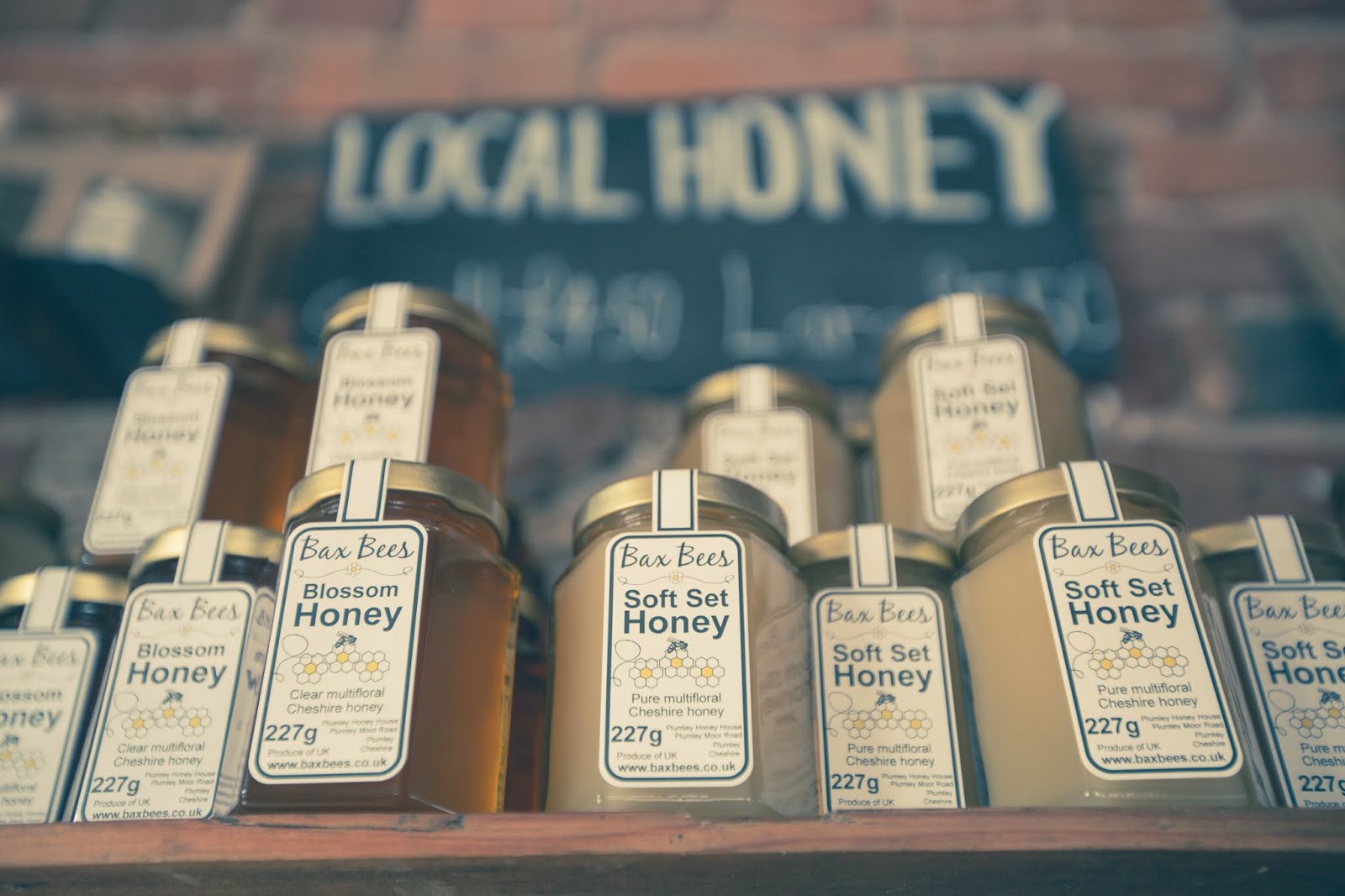
Honey is a natural sweetener we get from beehives.
Thirty-five percent of all crops in the US need bees to pollinate them, especially the California almond crop, which has to transport 1.5 million bee colonies from other states during pollination time, and then transport them out again after the pollination because, due to lack of cover crops, the bees don’t have pasture to feed on. After World War II, farmers started doing away with cover crops like alfalfa and clover, which had supplied bees with the nectar they need to make honey (https://youtu.be/dY7iATJVCso.)

The western honey bee, which is the most commonly known bee, while not in danger of extinction, has a declining population. More troubling is the decline of the wild bees, who are more susceptible to colony collapse disorder, in which bees just leave hives, often due to the effects of pesticides and herbicides. Bumblebees are also big pollinators, especially of tomatoes.  (https://youtu.be/oF8MV64NhrE.)

We need more beekeepers & bee friendly flowers to save the bees.
The varroa destructor mite is also a big killer of bees in this country. These mites attack the nervous system of bees, and make it so they cannot function as pollinators. (https://youtu.be/oF8MV64NhrE.)

What can we do to save bees? We can plant flowers. It sounds simple, yet if we start a campaign to plant bee friendly flowers in our yards, in public spaces, as hedge rows, as crop borders, and for cover crops, we can greatly enhance the pasture that bees have to enjoy. And, if we refrain from using herbicides and pesticides on our flowers, we will contribute to helping build back up the bee population.

We need bees! Help save them and ourselves. Without bees to pollinate our crops, we would be in danger of threatening our food supply. Beeware and bee wary of a world without bees. We are at a tipping point. No one wants to live in a food desert. Bee friendly and bee kind. Save the bees!


Tuesday, October 1, 2019

Birds I Have Known


Parakeets
When I was a girl, my Aunt Mickie gave my brother and me parakeets. We had a male and a female, which I learned you can tell by the color on their nostrils, or ceres, above their beaks—blue for a male, brown for a female.  I delighted in watching them flitting around their cage. I would let them out to fly around the house sometimes, too, so they could stretch their wings.
Tweety Pie & Sylvester

Once Aunt Mickie gave us a canary, which we named for her, “Mickie.” Boy, that bird had some chops! He enchanted me with his song. One day I let him out to fly and went away from the kitchen where we kept his cage for a few minutes. Later, I heard a loud “Oh, no!” from my brother, Bill. I ran into the kitchen, and saw the disgusting scene of my cat, Tiger, licking his chops, yellow bird feathers sticking out of the sides of his mouth. Mickie was no more. Evidently, Bill had let Tiger in by the back door, not realizing that Mickie was out of his cage. After that unfortunate incident, Aunt Mickie didn’t give us any more birds. 

For many years I kept bird feeders, enjoying watching the many birds that swooped into my backyard to enjoy the seeds, nuts, and dried fruit in these feeders. At some periods, I had to refill the eleven feeders every other day to keep them full. However, I do realize that I was also keeping the local squirrel population from going hungry, as well, even though I kept trying to find ways to discourage those little buggers from eating all the birdseed. The most frequent visitors to my backyard were the red-winged blackbirds. Sometimes my cat at the time, a smart, black Maine Coon, Milagro, and I would sit out back in the garden,watching  the birds as they flew in and ate the feed. He usually restrained himself and didn’t try to make the birds into a meal for himself! I was always surprised that the birds grew to ignore both me and Milagro as they chowed down.  
Red-winged Blackbird

I remember one blackbird that would often come down off the feeder and light other places in the yard. He’d sing what seemed to be especially for me. One day in autumn when the cool weather was spurring the birds to begin their yearly migrations, I was taking my dogs, a German Shepard/ wolf mix and a Chow/Lab mix,  for a walk by the pond across from my house. Milagro had followed us, as he was wont to do. There on the fence around the pond was a blackbird. As we approached, the  two big dogs, Bear, Bootsie, Milagro, and me, the bird did not fly off. Instead he began to chirp. I stopped a few feet from the wire fence to listen. The dogs and cat stopped and seemed to listen, too. After a minute or two of warbling, the blackbird took off, soaring up into the sky, joining a huge flock of birds flying overhead, heading southward. 

Maybe I am just being sentimental, but I felt that that was the same blackbird that had paid me so many visits that summer and fall in my backyard garden. It seemed like he was telling me ‘good bye’, acknowledging that we were friends somehow, if humans and avians can be friends. To this day I still miss that red-winged blackbird.

White-throated Sparrow
Many bird species are endangered. Since the 1970s, North America has lost 3 billion birds, nearly 30% of the total, and even common birds such as sparrows and blackbirds are in decline, U.S. and Canadian researchers report this week online in Science .Bird Study Just as a canary was sent down a mine shaft to make sure the air was safe to breathe, now birds are harbingers, signaling a greater global crisis in other species, such as insects, frogs, and other wildlife.

Baltimore Oriole
Climate change adds to the threats from habitat loss and invasive species, as well as creating new challenges that birds must overcome.Michael J. Parr, President of the American Bird Conservatory, urges the keeping of cats indoors, using decals on windows to prevent bird collisions, and creating wildlife habitat around homes. He says, "I implore everyone who cares about birds to take action now, at this crossroads for birds and for all nature.”American Bird Conservancy

For those who have children, get them a birding book and a set of binoculars, and take your children birdwatching. They will grow to love the birds and their songs as I did when I was a girl fishing with my Dad. He knew the call of most of every bird by heart. Such a big, strong, burly man, but he loved to imitate the sparrow's song or the call of a cardinal. Nature was in his blood. Let's make sure the birds are around on Earth for our children's children.
 
Cardinals in Winter painting by Pres. Jimmy Carter


Friday, September 20, 2019

Worldwide Climate Rally and Strike September 20, 2019


Today, September 20, 2019 over 2,800 actions took place over the world, which aim to “disrupt business as usual in order for people to know that this is a really serious moment,” says rally co-organizer Ashley McDermott, who also heads the Asheville chapter of the national Sunrise Movement (Asheville Climate Rally).

This was the largest climate march ever. According to the environmental group, 350.org, four million people participated worldwide including 300,000 in New York. Before the huge Manhattan crowd, 16-year-old Swedish climate activist, Greta Thunberg said, “Our house is on fire. We demand a safe future. Is it too much to ask?” (New York March).

Mika Baumeister Unsplash
This Monday, September 23rd is the United Nations Climate Summit and on September 21st is the first UN Youth Climate Summit. The United States will not be represented as we pulled out of the Paris Accords, unfortunately. Greta Thunberg will be speaking at the UN, representing her group, Fridays for Future, and continuing to be a shining example, inspiring other youth to take action on global warming since she believes adults are not doing much to prevent a climate disaster.

It is hard to argue with her logic. She is confused that in the United States, science is disparaged by some leaders, and it is debated. In Sweden, from which she comes, climate change is considered a scientific factual reality, and is not debated. 

If we don’t listen to the youth leading the climate movement, and if e continue to go on with our lives with our heads in the sand, ignoring global warming, melting of polar ice, escalating frequency and severity of storms, dying of the oceans, burning of the Amazon and other forests, extinction of thousands of animal species every year, loss of animal habitat, rising of the oceans, flooding of coastal areas, parching of once verdant earth, and on and on, what will become of us? What will become of the earth on which we depend for our very existence?

Let’s all take the earth pledge and then live by it. Let us cherish, honor, and take care of  our Earth Mother.

Pledge to the Earth

I pledge allegiance to the Earth
And to all life it nourishes:
All growing things, all species of animals,
 all races and genders of people.
I promise to protect all life on our planet.
To live in harmony with nature.
And to share our resources justly.
So that all people can live with dignity.
In good health and in peace.


Tuesday, September 10, 2019

What Role Can Men Play in Promoting Gender Equality?


Samantha Sophia Unsplash
Gender equality is often seen as a woman’s issue. Yet gender equality for women is good for men as well as women. I’m listing here a few steps that men can take to become allies to women in our struggle for gender equality.

1.    Acknowledge male privilege. Since men were born into a system in which men hold power and women are mostly excluded from it, they tend not to realize the benefits they are getting just from being born a male. A man who transitioned to a woman was amazed at what he was expected to endure as a woman that he does not have to put up with now as a man. 26-year-old Alex Poon, a Wellesley graduate, who transitioned from being a female to a male said, “Recently, I’ve been noticing the difference between being perceived as a woman versus being perceived as a man. I’ve been wondering how I can strike the right balance between remembering how it feels to be silenced and talked over with the privileges that come along with being perceived as a man.” Crossing the Divide

2.    Become allies with women. Simply not displaying male superiority is not enough. Women need men to be allies against all forms of discrimination and abuse. If someone catcalls a woman, call him down. If a man mansplains to a woman, point it out and expose it as demeaning to her. If women are not given proper scope to express their voices, advocate for them with other men.

3.    Challenge toxic masculinity. Don’t buy into stereotypes in which men have to be tough and cannot express their feelings. Become positive role models for other men, to show that caring for ourselves and the well being of others is not just a feminine trait. Listen more than you talk. Encourage boys to respect girls and treat them with kindness and fairness rather than feeling they have to make them into conquests to prove themselves. Girls everywhere are undervalued, undermined, and underestimated.

4.    Help transform power dynamics and support women taking the lead Men often fear that the empowerment of girls and women will mean losing some of their own status, but equality benefits us all. For example, distribution of child care and domestic tasks in the home encourages more satisfying and happy relationships. In the labor force, greater equality leads to better levels of production and satisfaction. Promoting women and girls’ leadership will create positive change in the whole community. Gender equality is not only a human right, but it is the foundation upon which we can build a better, more sustainable world.  We need both men and women fighting together to build an equal, inclusive, progressive society. Are you with us, men?