Saturday, November 30, 2019

November--Native American Heritage Month: Decolonizing Thanksgiving

1943 Norman Rockwell painting


A couple of days ago Americans enjoyed traditional meals with families and friends on Thanksgiving. Ever since I was in grade school I have heard the story of the first Thanksgiving in which Pilgrims and Native Americans sat down together for a feast. However, this idyllic story is nothing more than a myth based on colonialism, and has silenced the voices of Native Americans. This month is Native American Heritage Month, observed since 1990, a time to reflect on the history and contribution of Indigenous peoples.

Thanksgiving, a US holiday celebrating the national origin myth. Americans have been celebrating Thanksgiving for nearly four centuries, commemorating that solemn dinner in November, 1621. Thanksgiving was made a national holiday by Abraham Lincoln, who was lobbied by a prominent New England woman writer, to proclaim Thanksgiving a National Holiday to unify the nation after  the Civil War. Instead of a Thanksgiving celebration of the Pilgrims surviving their first winter in the New World, with the help of Squanto and his tribe, it was an entirely different affair (Indigenous History of Thanksgiving).

Harvard professor Philip Deloria, of the Dakota tribe, son of famous Dakota historian, author, and activist, Vine Deloria, Jr., sheds light on what the first Thanksgiving was really like. He tells the story of Ousamequin, the Massasoit (which is a title and not his name), who arrived, uninvited, with many warriors, to honor a mutual defense pact, after they heard shots, thinking the Pilgrims were under attack. The supposed celebratory meal of the Pilgrims did not entail the giving of food as a gift between the Native Americans and the colonizers. The traditional holiday foods like corn, squash, and pumpkin were stolen from the Wampanaog who were treated as servants at the meal. The meat could have been wild turkey, but also included fish, eels, shellfish, and a Wampanoag dish called nasaump, which the Pilgrims had adopted: boiled cornmeal mixed with vegetables and meat (P. Deloria New Yorker Article).

 Historian Roxane Dunbar-Ortiz, in her 2015 American Book Award Winning work, An Indigenous Peoples’ History of the United States, asserts that the idea of the gift-giving Indian helped establish what would become the United States, “an insidious smoke screen meant to obscure the fact that the very existence of the country is a result of the looting of an entire continent and its resources.” Protesting against the holiday, the United American Indians of New England have held a “National Day of Mourning” at Plymouth Rock since 1970.

Deconstructing the Thanksgiving Myth. How do we deconstruct the myth of Thanksgiving? We falsely remember a Thanksgiving of intercultural harmony. Maybe instead we should reflect on how English settlers cheated, abused, killed, and eventually drove Wampanoags into a conflict, known as King Philip’s War (1675-6), one of the most devastating wars in the history of North American settlement, in which a large percentage of the settler population was killed. The Thanksgiving story buries the major cause of King Philip’s War, the relentless seizure of Indian land. With indigenous resistance broken, Wamanoags were judged to be criminals; many were sold into slavery. (P. Deloria New Yorker Article).

Today, the Wampanoag make up two federally recognized tribes, the Mashpee Wampanoag Tribe and the Wampanoag Tribe of Gay Head, and they descend from a confederation of groups that stretched across large areas of Massachusetts, including Cape Cod, Martha’s Vineyard, and Nantucket.

Bioneers Indigenous Youth  Project (photo-Rena Schild)
Decolonizing Thanksgiving. If classroom teachers today focus less on pageantry and instead on a more nuanced, inclusive history, still many students do not get the complete story about the place of Native peoples in the nation’s past or current history. Roxane Dunbar-Ortiz states, “it’s time for the United States government to make a gesture toward acknowledgment of its colonial past and a commitment to decolonization” (An Indigenous Peoples’ History of the United States). Today, Wampanoag people debate whether Thanksgiving should be a day of mourning or a chance to contemplate reconciliation.

The Bioneers Indigeneity Program has a mission to provide public education around Native perspectives. They have a blog post to share some ideas for new traditions to include at your Thanksgivings to better honor the Native Americans, immigrants, and their descendants who contribute to our country’s diversity (Bioneers Indigeneity Program).

Below are three new traditions suggested by the Bioneers you can adopt to begin to decolonize Thanksgiving:

1. Combat erasure by telling the real story of Thanksgiving around the table (Indigenous History of Thanksgiving).
 2. Re-center Thanksgiving by serving locally sourced food. Your local farmers market is a great place to find locally grown foods.
3. Address oppression by widening your circle.  Ask someone outside your usual group of friends and family what Thanksgiving means to them (Decolonizing Thanksgiving).


.

Wednesday, November 6, 2019

What's Happening to the Bees?


Most everyone I know has been stung by a bee at some point in their lives. When I was five or six years old, I was walking barefoot in our back yard. I was stooping to smell dandelions, violets, and the hollyhock bush, as little girls are wont to do. Suddenly I felt a sharp pain in my little toe of my left foot. I bent down to see what I had stepped on—it was a bumble bee, and she was stinging me with all her might.  I think I picked the bee off my toe, and with tears streaming down my face, went into the house to find my mama.
Bees use pollen & nectar to make honey & propolis.

Another time, while hanging clothes on the clothesline stretched out in our back yard, I bumped the metal post to which double wire clotheslines were attached. Out buzzed angry hornets, I think they were hornets because wasps are less likely to attack humans, from my research. Whatever they were, I took off like a rocket on the launching pad as they buzzed after me! I got a few stings, but it could have been much worse had I not immediately run for the basement door. Yikes! It hurt!

Well, as annoying as bees, yellow jackets, and wasps can be sometimes, they play a key role in pollinating plants. At least bees and yellow jackets are pollinators; wasps and hornets, which are actually a kind of wasp, eat other insects, helping to control them so they won’t destroy farmers’ crops.

Bees are in trouble. Since World War II, bee populations have been in decline. In 1945 there were 4.5 million bee colonies. In 2007 there were only 2 million colonies.  Why the decline? There are three main reasons: 1. Use of pesticides on crops, 2. diseases, and 3. the flowerless landscapes of the monoculture of high profit crops like corn and soybeans (http://sciabc.us/9PpyLG.)

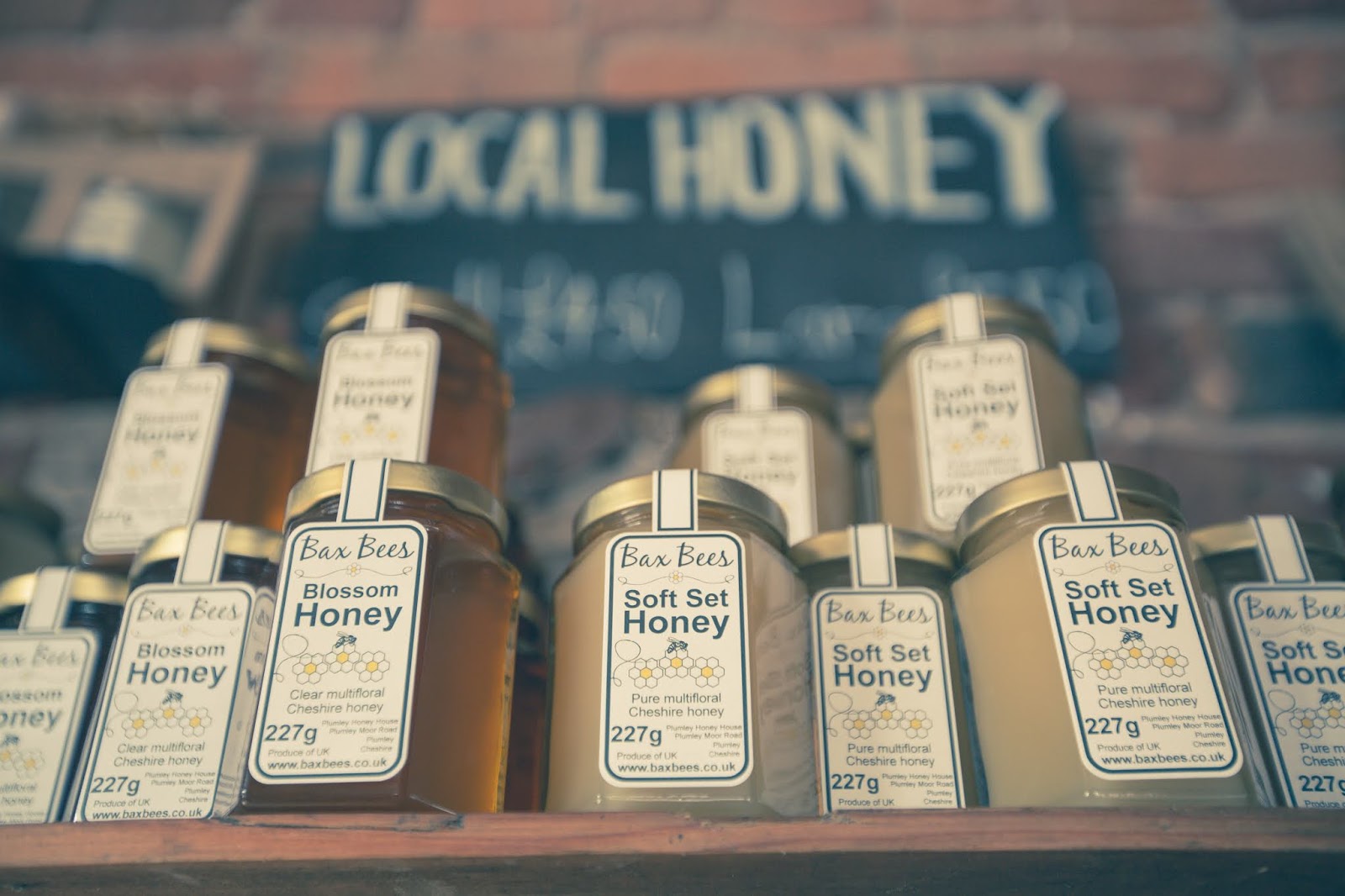
Honey is a natural sweetener we get from beehives.
Thirty-five percent of all crops in the US need bees to pollinate them, especially the California almond crop, which has to transport 1.5 million bee colonies from other states during pollination time, and then transport them out again after the pollination because, due to lack of cover crops, the bees don’t have pasture to feed on. After World War II, farmers started doing away with cover crops like alfalfa and clover, which had supplied bees with the nectar they need to make honey (https://youtu.be/dY7iATJVCso.)

The western honey bee, which is the most commonly known bee, while not in danger of extinction, has a declining population. More troubling is the decline of the wild bees, who are more susceptible to colony collapse disorder, in which bees just leave hives, often due to the effects of pesticides and herbicides. Bumblebees are also big pollinators, especially of tomatoes.  (https://youtu.be/oF8MV64NhrE.)

We need more beekeepers & bee friendly flowers to save the bees.
The varroa destructor mite is also a big killer of bees in this country. These mites attack the nervous system of bees, and make it so they cannot function as pollinators. (https://youtu.be/oF8MV64NhrE.)

What can we do to save bees? We can plant flowers. It sounds simple, yet if we start a campaign to plant bee friendly flowers in our yards, in public spaces, as hedge rows, as crop borders, and for cover crops, we can greatly enhance the pasture that bees have to enjoy. And, if we refrain from using herbicides and pesticides on our flowers, we will contribute to helping build back up the bee population.

We need bees! Help save them and ourselves. Without bees to pollinate our crops, we would be in danger of threatening our food supply. Beeware and bee wary of a world without bees. We are at a tipping point. No one wants to live in a food desert. Bee friendly and bee kind. Save the bees!


Tuesday, October 1, 2019

Birds I Have Known


Parakeets
When I was a girl, my Aunt Mickie gave my brother and me parakeets. We had a male and a female, which I learned you can tell by the color on their nostrils, or ceres, above their beaks—blue for a male, brown for a female.  I delighted in watching them flitting around their cage. I would let them out to fly around the house sometimes, too, so they could stretch their wings.
Tweety Pie & Sylvester

Once Aunt Mickie gave us a canary, which we named for her, “Mickie.” Boy, that bird had some chops! He enchanted me with his song. One day I let him out to fly and went away from the kitchen where we kept his cage for a few minutes. Later, I heard a loud “Oh, no!” from my brother, Bill. I ran into the kitchen, and saw the disgusting scene of my cat, Tiger, licking his chops, yellow bird feathers sticking out of the sides of his mouth. Mickie was no more. Evidently, Bill had let Tiger in by the back door, not realizing that Mickie was out of his cage. After that unfortunate incident, Aunt Mickie didn’t give us any more birds. 

For many years I kept bird feeders, enjoying watching the many birds that swooped into my backyard to enjoy the seeds, nuts, and dried fruit in these feeders. At some periods, I had to refill the eleven feeders every other day to keep them full. However, I do realize that I was also keeping the local squirrel population from going hungry, as well, even though I kept trying to find ways to discourage those little buggers from eating all the birdseed. The most frequent visitors to my backyard were the red-winged blackbirds. Sometimes my cat at the time, a smart, black Maine Coon, Milagro, and I would sit out back in the garden,watching  the birds as they flew in and ate the feed. He usually restrained himself and didn’t try to make the birds into a meal for himself! I was always surprised that the birds grew to ignore both me and Milagro as they chowed down.  
Red-winged Blackbird

I remember one blackbird that would often come down off the feeder and light other places in the yard. He’d sing what seemed to be especially for me. One day in autumn when the cool weather was spurring the birds to begin their yearly migrations, I was taking my dogs, a German Shepard/ wolf mix and a Chow/Lab mix,  for a walk by the pond across from my house. Milagro had followed us, as he was wont to do. There on the fence around the pond was a blackbird. As we approached, the  two big dogs, Bear, Bootsie, Milagro, and me, the bird did not fly off. Instead he began to chirp. I stopped a few feet from the wire fence to listen. The dogs and cat stopped and seemed to listen, too. After a minute or two of warbling, the blackbird took off, soaring up into the sky, joining a huge flock of birds flying overhead, heading southward. 

Maybe I am just being sentimental, but I felt that that was the same blackbird that had paid me so many visits that summer and fall in my backyard garden. It seemed like he was telling me ‘good bye’, acknowledging that we were friends somehow, if humans and avians can be friends. To this day I still miss that red-winged blackbird.

White-throated Sparrow
Many bird species are endangered. Since the 1970s, North America has lost 3 billion birds, nearly 30% of the total, and even common birds such as sparrows and blackbirds are in decline, U.S. and Canadian researchers report this week online in Science .Bird Study Just as a canary was sent down a mine shaft to make sure the air was safe to breathe, now birds are harbingers, signaling a greater global crisis in other species, such as insects, frogs, and other wildlife.

Baltimore Oriole
Climate change adds to the threats from habitat loss and invasive species, as well as creating new challenges that birds must overcome.Michael J. Parr, President of the American Bird Conservatory, urges the keeping of cats indoors, using decals on windows to prevent bird collisions, and creating wildlife habitat around homes. He says, "I implore everyone who cares about birds to take action now, at this crossroads for birds and for all nature.”American Bird Conservancy

For those who have children, get them a birding book and a set of binoculars, and take your children birdwatching. They will grow to love the birds and their songs as I did when I was a girl fishing with my Dad. He knew the call of most of every bird by heart. Such a big, strong, burly man, but he loved to imitate the sparrow's song or the call of a cardinal. Nature was in his blood. Let's make sure the birds are around on Earth for our children's children.
 
Cardinals in Winter painting by Pres. Jimmy Carter


Friday, September 20, 2019

Worldwide Climate Rally and Strike September 20, 2019


Today, September 20, 2019 over 2,800 actions took place over the world, which aim to “disrupt business as usual in order for people to know that this is a really serious moment,” says rally co-organizer Ashley McDermott, who also heads the Asheville chapter of the national Sunrise Movement (Asheville Climate Rally).

This was the largest climate march ever. According to the environmental group, 350.org, four million people participated worldwide including 300,000 in New York. Before the huge Manhattan crowd, 16-year-old Swedish climate activist, Greta Thunberg said, “Our house is on fire. We demand a safe future. Is it too much to ask?” (New York March).

Mika Baumeister Unsplash
This Monday, September 23rd is the United Nations Climate Summit and on September 21st is the first UN Youth Climate Summit. The United States will not be represented as we pulled out of the Paris Accords, unfortunately. Greta Thunberg will be speaking at the UN, representing her group, Fridays for Future, and continuing to be a shining example, inspiring other youth to take action on global warming since she believes adults are not doing much to prevent a climate disaster.

It is hard to argue with her logic. She is confused that in the United States, science is disparaged by some leaders, and it is debated. In Sweden, from which she comes, climate change is considered a scientific factual reality, and is not debated. 

If we don’t listen to the youth leading the climate movement, and if e continue to go on with our lives with our heads in the sand, ignoring global warming, melting of polar ice, escalating frequency and severity of storms, dying of the oceans, burning of the Amazon and other forests, extinction of thousands of animal species every year, loss of animal habitat, rising of the oceans, flooding of coastal areas, parching of once verdant earth, and on and on, what will become of us? What will become of the earth on which we depend for our very existence?

Let’s all take the earth pledge and then live by it. Let us cherish, honor, and take care of  our Earth Mother.

Pledge to the Earth

I pledge allegiance to the Earth
And to all life it nourishes:
All growing things, all species of animals,
 all races and genders of people.
I promise to protect all life on our planet.
To live in harmony with nature.
And to share our resources justly.
So that all people can live with dignity.
In good health and in peace.


Tuesday, September 10, 2019

What Role Can Men Play in Promoting Gender Equality?


Samantha Sophia Unsplash
Gender equality is often seen as a woman’s issue. Yet gender equality for women is good for men as well as women. I’m listing here a few steps that men can take to become allies to women in our struggle for gender equality.

1.    Acknowledge male privilege. Since men were born into a system in which men hold power and women are mostly excluded from it, they tend not to realize the benefits they are getting just from being born a male. A man who transitioned to a woman was amazed at what he was expected to endure as a woman that he does not have to put up with now as a man. 26-year-old Alex Poon, a Wellesley graduate, who transitioned from being a female to a male said, “Recently, I’ve been noticing the difference between being perceived as a woman versus being perceived as a man. I’ve been wondering how I can strike the right balance between remembering how it feels to be silenced and talked over with the privileges that come along with being perceived as a man.” Crossing the Divide

2.    Become allies with women. Simply not displaying male superiority is not enough. Women need men to be allies against all forms of discrimination and abuse. If someone catcalls a woman, call him down. If a man mansplains to a woman, point it out and expose it as demeaning to her. If women are not given proper scope to express their voices, advocate for them with other men.

3.    Challenge toxic masculinity. Don’t buy into stereotypes in which men have to be tough and cannot express their feelings. Become positive role models for other men, to show that caring for ourselves and the well being of others is not just a feminine trait. Listen more than you talk. Encourage boys to respect girls and treat them with kindness and fairness rather than feeling they have to make them into conquests to prove themselves. Girls everywhere are undervalued, undermined, and underestimated.

4.    Help transform power dynamics and support women taking the lead Men often fear that the empowerment of girls and women will mean losing some of their own status, but equality benefits us all. For example, distribution of child care and domestic tasks in the home encourages more satisfying and happy relationships. In the labor force, greater equality leads to better levels of production and satisfaction. Promoting women and girls’ leadership will create positive change in the whole community. Gender equality is not only a human right, but it is the foundation upon which we can build a better, more sustainable world.  We need both men and women fighting together to build an equal, inclusive, progressive society. Are you with us, men?


Monday, September 2, 2019

Pledge to the Earth

I was pleasantly surprised early Friday morning when I heard my elementary school students reciting "The Pledge to the Earth" instead of "The Pledge of Allegiance." I thought perhaps my ears were deceiving me, but then I noticed a huge poster propped up on the whiteboard with words to this Earth pledge. It was exciting! When I substitute teach, at the start of each school day, when the pledge is broadcast over the PA system, I  do not repeat it. I have been refusing to repeat this patriotic pledge decades before NFL football star, Colin Kaepernick and his '49ers teammate Eric Reid, starting taking a knee during the National Anthem played at NFL games. 


The Pledge of Allegiance


I pledge allegiance to the flag of the United State of America, and to the republic for which it stands, one nation under God, indivisible, with liberty and justice for all. (Francis Bellamy, 1892, socialist minister) 
The words, 'under God' were added by the direction of President Eisenhower, to counter what he believed was the communist threat. Rev. Bellamy's daughter objected, but to no avail.

Not saying the Pledge of Allegiance and not standing for the National Anthem is essentially the same issue. I no longer believe that the U.S. government is upholding human values, much as Kaepernick wished to call attention to the racism and police brutality practiced in the U.S., which is inconsistent with values stated in the National 
Anthem.
Kaepernick and Reid Protesting Racism

 Kaepernick has pretty much been blackballed by the NFL, not being picked up to play in 2017 and subsequent years. His protest has been misconstrued as unpatriotic by the President, some NFL coaches and others. He wasn't protesting the flag and national anthem. He was using his social platform to protest police brutality and the lack of accountability of the justice system toward African Americans.  Healthy protest should be encouraged, not punished. 

I feel a bit apprehensive every time my students watch me as I am silent when I am supposed to be leading them in the "Pledge of Allegiance." I hope I don't get reported to any school administration for my lack of acquiescence to this practice. So far, so good. I am waiting for a student to ask me why I don't recite the pledge. That could be a tricky question to answer.

Here is the "Pledge to the Earth" written by teachers at a school here in Asheville, North Carolina. I added the "and genders" part.


Pledge to the Earth
I pledge allegiance to the Earth
And to all life it nourishes:
All growing things, all species of animals, 
All races and genders of people.
I promise to protect all life on our planet.
To live in harmony with nature.
And to share our resources justly.
So that all people can live with dignity.
In good health and in peace.

Ricardo Resende Unsplash
I love this new pledge. I can get behind it. It is based on neohumanism, a theory which includes all people, plants, animals, and the environment in one interconnected whole, the circle of life. It's a pledge every person in the world could take. I hope we all do. Yay, Mother Earth!


Tuesday, August 27, 2019

Pull on Those Covers! School Has Started.

For the first time this summer, I woke up at night because I was chilled and had to pull on more covers. Brr! Technically, we still have summer for another month, until September 23rd, the autumn equinox. Yet the weather already feels a little fall-like, Personally, I associate the beginning of the new school term with fall, and since schools have already started up, for me, it is fall.

Photo by Oliver Hale, Unsplash
Why did schools start beginning their fall terms in August, rather than September?

"Some have called long summer breaks a holdover from our agricultural past. That is not true. In fact, in the South, for much of the 20th century, schools took shorter summer breaks so that school could be dismissed in the fall, allowing children to help their parents pick cotton." (https://www.tuscaloosanews.com/opinion/20101126/editorial-longer-summer-breaks-good-for-students-parents)

 When I attended public school in the 50s and 60s, school started after Labor Day. So why did the fall back-to-school time get pushed up to August? Daphne Sasson, an Atlanta native, discusses the issue in an article on CNN. She says that in Atlanta schools first started beginning in August in 1996.She gives some reasons for a start date earlier than the traditional Labor Day date. 1.)There is more instructional time before spring assessments. 2.) Students can finish first semester before the December holiday break, so teachers won't need to review when school starts in January. (https://www.cnn.com/2015/08/04/living/school-start-dates-august-parents-feat/index.html)

Well, yes, I do get it, but we get less and less summer every year. I know the tourist trade would love for schools to get back to a September start date. Not that I am a fan of the tourist industry, yet in this case, I agree. Students need a longer summer vacation.  Families need time to go on vacations. Children need time to play with their friends.

Photo by Jon Tyson, Unsplash
Maybe it is nostalgia, but I yearn for the days when cooler weather meant that it was the end of summer and kids would start getting ready to go back to school. It seems like we are  rushing kids so much these days. They have to learn facts to regurgitate on assessments. Teachers have to teach to these tests, rather than instilling the love of learning and giving students tools with which to learn. These standardized assessments have changed the way teachers have to teach, or get fired for low scores of their students on the tests. They have changed the way students learn. Instead of learning to solve problems and become critical thinkers, they have to devote much of their time and energy to memorizing and learning the facts that may appear on these tests. So much for progressive education...

I know about this because as a classroom teacher, I was forced to teach to these tests. Some teachers were threatened that if their students didn't measure up, they would lose their jobs. Hard to do in an inner-city school in which my 10th grade students were reading on a 6th grade level when they arrived in my English classes. Some students did better, but a great number needed remedial reading instruction.

My students were not dumb. But school had become so much more than a place to learn. It was a place that if they wore the wrong color, a rival gang member might beat them up. School was a place to either score drugs or try to avoid running into pushers and druggies. School was a place they could get beaten up if they wore expensive athletic shoes that someone else wanted to steal for themselves. School was a place you had to avoid avoid bullies. In other words, the culture of school often overshadowed the instruction that was taking place in the classroom. And so many of my students were homeless or in homes in which parents were drug users and not supporting their child's school life.

My point, I guess, is that the defective educational curriculum with its standardized test requirements drives more than the earlier start dates of schools. Schools must work to collaborate with parents and teachers to create curricula that work for each locality. We must realize that social issues crop into our schools, and hinder learning. We must work to address these non-instructional needs of students--safety, hunger, homelessness, poverty, abuse, teen pregnancy, drug use, gang violence, school shootings, and so much more.

Photo by Jonathan Borba, Unsplash
Today's public school students have so many more challenges they face in school than I did  decades ago. With funding for public schools being cut, and charter schools and expensive private schools getting more and more of the resources, I don't see the problems with public schooling getting better any time soon. We need a transformation in educational pedagogy, which can only happen with an administration that believes in education as a right for all, regardless of race, gender, and social class. We must advocate for such a change. Children are our future.